

If you asked me the one thing you could do to improve your nutrition in Menopause and beyond, I would say.
Improve your gut health.
Whilst gut health research dates back to as early as 1840, In 1998, Michael Gershon published a popular science book titled The Second Brain, in which the author elaborates a scientific discovery called revolutionary for its time: that the nerve cells in the gut have an independent, not brain-controlled influence on the functions of the intestine. The gut brain connection was discovered. So quite a new phenomena, and the research continues.
Menopause can have several gastrointestinal symptoms, ranging from constipation and diarrhoea to bloating, indigestion, weight loss or gain to heartburn and vomiting. Most people think about changes to the ovaries and the uterus when considering menopause.
Decreasing amounts of oestrogen and progesterone during menopause can slow down the process of food passing through the GI system. When the digestive process takes longer, more water is reabsorbed back into the bloodstream, which can lead to the constipation, increased gas and bloating
Another key finding is that menopause changes the community of bacteria living in the gut, which is called the microbiome. There is a link between certain gut bacteria and better memory.
Probiotics may help ease menopause symptoms and regulate body weight, but their effectiveness remains controversial. More research is needed to explore and support the health benefits associated with probiotic use during the various stages of menopause.
In the meantime the foods I am suggesting you eat regularly here can also help with the following symptoms of ageing:
Skin elasticity
Improves sleep
Improves joint pains
Improves memory
Improves bloating
Improves weight loss
So what should you be eating on a gut healthy diet?
Yogurt
Kefir
Miso
Sauerkraut
Kimchi
Almonds
Kombucha
Peas/beans/lentils
Brussel sprouts
Bananas
Blue cheese
Garlic
Ginger
Some of those foods you probably won’t even recognize their names or even know what they are. Here is a video of me going around the supermarket finding these foods to help you to get them into your life.
Gut health is the future key to optimum health for the meno and beyond woman.
If you would like help to build these foods into your daily/weekly menu come and join me online for the next 7 day Menofit Midsection Meltdown on 12th June 2023. CLICK HERE FOR EARLY BIRD OFFER


During menopause, dryness is often an issue. This is likely caused by the decrease in oestrogen levels. Drinking water can help with these symptoms. Drinking water can also reduce the bloating that can occur with hormonal changes.
So, let’s take a look at some of the signs to look out for that can indicate that you are not drinking enough water.
If your urine looks dark, if it starts to smell as well, that’s the number one signal that your body is telling you that it’s dehydrated. Healthy urine should be very, very pale and should have little or no odour at all.
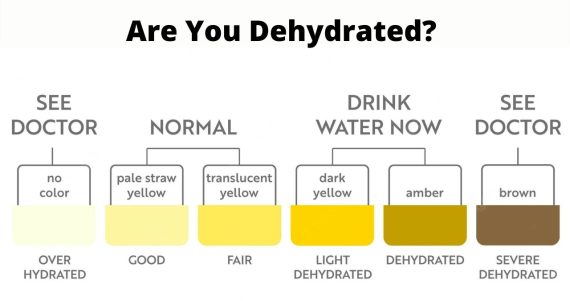
It’s one of these weird things. When you drink less, you may end up going to the toilet more. But why? Well, as you get more and more dehydrated, your dark, smelly urine can become very concentrated, which irritates your bladder. It can get to the point where your bladder can become quite raw and give you symptoms like cystitis without any infection present.
When that happens, this really strong urine will just keep irritating your bladder, you will very often get a real urge to go to the toilet very quickly, you will go, and you’ll only pass a little bit of urine.
This is a standard scenario during the night. Very often, a lot of women have to get up two or three times during the night to go to the toilet. And when they go, they pass very little urine. It can sometimes be a little bit stingy. This is usually just caused by being dehydrated during the night.
Again, as I mentioned above, this is a bit of a vicious cycle! Hot flushes and night sweats can dehydrate you, but being dehydrated will put more pressure on your nervous system, which will also trigger more hot flushes and night sweats.
Tiredness, fatigue, and feeling lethargic are classic signs of dehydration! If you’re dehydrated, your body just won’t want to move.
This often goes hand-in-hand with feeling tired and lethargic. Brain fog and loss of concentration at the same time every day is another classic sign of dehydration, as well as a sign of low blood sugar level.
Your brain is full of water and is like a sponge. It needs lots of water. It’s been shown that if you get dehydrated, your brain shrinks in volume, which impacts how it functions. (1)
Even mild dehydration can affect the proper functioning of your brain and make menopausal brain fog even worse.
If your brain is physically shrinking due to dehydration, as well as impacting brain function, you can also experience dehydration headaches, which can be similar to tension and thumping headaches.
Palpitations, again, can be due to dehydration. So, if you are getting palpitations at the same time every day, which often happens in this kind of situation, then, again, it just means that you’ve probably gone too long without that drink of water.
This is really common first thing in the morning. A lot of women will tell me that they feel as if their tongue is stuck to the roof of their mouth. And, again, this is often caused by becoming dehydrated during the night, especially if you have night sweats.
Your digestive tract needs lots of water to process and eliminate all the food that you’re eating. And if you’re dehydrated, everything just slows down and literally just sticks.
Joint pain and muscle cramps are both common symptoms of dehydration. Another great signal of dehydration is low back pain. If you’re getting a lot of back pain on both sides of the spine regularly, that’s very often your kidneys just complaining that they are feeling the dehydration as well.
Dehydration can greatly impact your mood, something that is already impacted during menopause. It can make you feel low and sad or irritable and angry. So, if you find you’re getting a low mood or irritable, sometimes, a glass of water can fix it.
They do say that it can be difficult to distinguish between thirst and hunger. So sometimes, if you are starting to feel hungry, if you’re getting sugar cravings, then it’s a sign that you are dehydrated, and your body is needing water and not food.