
How Yin Yoga can help the Menopausal Woman
As you know my business focusses solely on the Menopausal and beyond woman, her physical, nutritional and metal needs. The missing piece was a practice which helps us to learn to stop, listen and reflect.

As you know my business focusses solely on the Menopausal and beyond woman, her physical, nutritional and metal needs. The missing piece was a practice which helps us to learn to stop, listen and reflect.


Remember, it’s always important to consult with your healthcare provider before making any significant changes to your diet, exercise routine, or considering hormone replacement therapy. They can provide personalised advice based on your specific needs and medical history.
At our next Well-Being Day on 21st September, we will focus on bone density, all the exercise sessions, lunch and talks will be based around this important Post Menopause Health Consideration.

Heart disease is the number one killer of women in the UK, and there are currently more than 3.6 million women in the UK living with heart disease. Coronary heart disease kills more than twice as many women as breast cancer, and each year, more than 30,000 women in the UK are admitted to hospital due to a heart attack.
Heart disease refers to a range of conditions that affect the heart and blood vessels. While the types of heart disease are generally similar in both men and women, there are certain conditions and risk factors that may be more prevalent or have unique characteristics in women. Here are some of the different types of heart disease that affect women in the UK:

It’s important to note that while these types of heart disease are more commonly associated with women, they can affect individuals of any gender. Additionally, risk factors such as high blood pressure, high cholesterol, diabetes, obesity, smoking, and a family history of heart disease apply to both men and women. If you have concerns about heart disease or any specific symptoms, it’s advisable to consult a healthcare professional for a proper evaluation and guidance.

Many of the ladies in my online groups and Pilates classes are in fact enjoying their Post-menopausal years. Often I hear them say, ‘I don’t need to worry about all that now, I went through the change years ago’.
The truth is that post menopause, which incidentally can now be up to and beyond 30 more years, you are more at risk of chronic health issues. Let’s not forget that the average age of death for a woman only 100 years ago was only 59 years. Which would have meant the woman would only have been post-menopausal for a few years.

So, now, because of the changes in how the hormones are produced in your body, as well as the 21st century lifestyle issues, we need to be highly aware of the things you can do to help yourself. And, yes, there are lots.
Heart Disease
Risk: During and after the menopause, a woman’s body gradually produces less oestrogen than it used to. This increases the risk of the coronary arteries narrowing whereas it previously protected the lining of the artery walls reducing the build-up of plaque. This period is also associated with accelerated vascular aging (arterial stiffening and endothelial dysfunction), an antecedent to CVD.
What you can do: Exercise which will make you out of breath and sweat. Walking up hill, cycling, aerobics, jogging. Eat a healthy diet (see below)
Cognitive decline
Risk: Alzheimer’s and dementia one of the leading causes of death in women in the UK. This could be to do with women living longer and being treated well for other issues. There are many things you can do to help yourself in this regard. Vascular dementia is about managing your blood pressure, and blood sugars.
What you can do: Daily moderate exercise, Eat and healthy energy efficient diet (see below), learn something new, keep being sociable.
Muscle mass loss
Risk: Sarcopenia is a condition by which you loose muscle strength. Causes include declines in hormones and numbers of neuromuscular junctions, increased inflammation, declines in activity, and inadequate nutrition.
What you can do: The primary treatment for sarcopenia is exercise, specifically resistance training or strength training. These activities increase muscle strength and endurance using weights or resistance bands. Resistance training can help your neuromuscular system, hormones. Eat a healthy protein rich diet (see below)
Bone thinning
Risk: Osteoporosis weakens bones to the point that they can break easily. It is called a “silent disease” because people who develop it may not notice any changes until a bone breaks — usually a bone in the hip, spine, or wrist. You are 50% more likely to get this as oestrogen was one of the main hormones to help build your bones.
What you can do: Regular (3 times a week) strength and resistance training exercises, Eat a healthy diet (see below), stop smoking, drink less alcohol.
All of these things require you to eat a healthy diet, but what does that look like? I’ll show you in my next Menofit Midsection Meltdown, online 7 day program. Not only will I do easy to do 15 minute exercise sessions perfectly designed with the menopausal woman in mind, but also guide you through a healthy eating plan, which will help you to stay healthy for the rest of your life. £34 early bird price. PAY NOW


During menopause, dryness is often an issue. This is likely caused by the decrease in oestrogen levels. Drinking water can help with these symptoms. Drinking water can also reduce the bloating that can occur with hormonal changes.
So, let’s take a look at some of the signs to look out for that can indicate that you are not drinking enough water.
If your urine looks dark, if it starts to smell as well, that’s the number one signal that your body is telling you that it’s dehydrated. Healthy urine should be very, very pale and should have little or no odour at all.
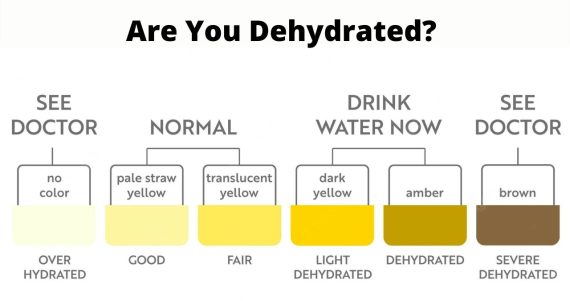
It’s one of these weird things. When you drink less, you may end up going to the toilet more. But why? Well, as you get more and more dehydrated, your dark, smelly urine can become very concentrated, which irritates your bladder. It can get to the point where your bladder can become quite raw and give you symptoms like cystitis without any infection present.
When that happens, this really strong urine will just keep irritating your bladder, you will very often get a real urge to go to the toilet very quickly, you will go, and you’ll only pass a little bit of urine.
This is a standard scenario during the night. Very often, a lot of women have to get up two or three times during the night to go to the toilet. And when they go, they pass very little urine. It can sometimes be a little bit stingy. This is usually just caused by being dehydrated during the night.
Again, as I mentioned above, this is a bit of a vicious cycle! Hot flushes and night sweats can dehydrate you, but being dehydrated will put more pressure on your nervous system, which will also trigger more hot flushes and night sweats.
Tiredness, fatigue, and feeling lethargic are classic signs of dehydration! If you’re dehydrated, your body just won’t want to move.
This often goes hand-in-hand with feeling tired and lethargic. Brain fog and loss of concentration at the same time every day is another classic sign of dehydration, as well as a sign of low blood sugar level.
Your brain is full of water and is like a sponge. It needs lots of water. It’s been shown that if you get dehydrated, your brain shrinks in volume, which impacts how it functions. (1)
Even mild dehydration can affect the proper functioning of your brain and make menopausal brain fog even worse.
If your brain is physically shrinking due to dehydration, as well as impacting brain function, you can also experience dehydration headaches, which can be similar to tension and thumping headaches.
Palpitations, again, can be due to dehydration. So, if you are getting palpitations at the same time every day, which often happens in this kind of situation, then, again, it just means that you’ve probably gone too long without that drink of water.
This is really common first thing in the morning. A lot of women will tell me that they feel as if their tongue is stuck to the roof of their mouth. And, again, this is often caused by becoming dehydrated during the night, especially if you have night sweats.
Your digestive tract needs lots of water to process and eliminate all the food that you’re eating. And if you’re dehydrated, everything just slows down and literally just sticks.
Joint pain and muscle cramps are both common symptoms of dehydration. Another great signal of dehydration is low back pain. If you’re getting a lot of back pain on both sides of the spine regularly, that’s very often your kidneys just complaining that they are feeling the dehydration as well.
Dehydration can greatly impact your mood, something that is already impacted during menopause. It can make you feel low and sad or irritable and angry. So, if you find you’re getting a low mood or irritable, sometimes, a glass of water can fix it.
They do say that it can be difficult to distinguish between thirst and hunger. So sometimes, if you are starting to feel hungry, if you’re getting sugar cravings, then it’s a sign that you are dehydrated, and your body is needing water and not food.

It all so confusing these days. There’s so much information out there, calorie counting, low fat, fasting, high protein…. where should you start?
As a 50 woman myself, I feel your pain. So, lets take some time to get back to basics and learn about the foundations of nutrition and habit change.


Do you regularly wake up early and can’t get back to sleep?
Are you just longing for a GOOD nights sleep so you can actually do something productive during the day?
Sleep is SO important for us when we reach our 40’s and 50’s, here’s why:
What can we do?:
